The real cost of one bad live-chat reply (run your own numbers)
Support Coach AI · September 2026
One risky reply costs you some blend of five things: the customer relationship, the escalation time it triggers, the manager hours it consumes, the review it may earn, and the discount or refund used to smooth it over. You'll find plenty of articles quoting dramatic industry statistics about the "cost of bad service." We're not going to do that — those numbers rarely survive a request for the source. Here's something more useful: a worksheet you can run with numbers you already know.
The five costs, and where to find your numbers
1. The relationship. What is your average customer worth per year? For a subscription business, that's your ARPA. A reply that reads as blame ("you entered it wrong") doesn't always churn the account — but it moves the account into play. You know your own margin for error here better than any benchmark does.
2. The escalation. When a chat goes sideways, how many extra touches does it take to land it — the follow-up messages, the call-back, the "let me loop in my manager"? Each is minutes multiplied by loaded hourly cost, and it's usually your senior people doing the recovery.
3. Manager time. An escalated customer reaches a manager as a fire: read the transcript, calm the customer, coach the agent. Even a modest incident routinely consumes an hour of the most expensive support time you have.
4. The public review. Not every bad chat becomes a one-star review — but read your own worst reviews and count how many quote a thing a support person said. A written reply is quotable in a way a phone call never was.
5. The make-good. The discount, the refund, the comped month that closes the incident. Directly measurable in your own books, and almost always larger than the price of preventing the message that caused it.
The arithmetic that matters
The uncomfortable multiplication: none of these costs scales down with team size. A solo founder answering chats and a fifty-agent floor both lose the same account when the same sentence goes out — timing is the whole game, because every one of the five costs attaches at the moment the customer reads the reply. Reviewing the conversation next week (which is what QA tooling does, typically at ~$35 per agent per month) improves the next conversation. It refunds nothing on this one.
So the comparison worth writing down: take one realistic incident — your ARPA, plus an hour of manager time, plus a make-good — and put it next to the cost of a second look at every risky draft before send. For Support Coach that's $15 per agent per month. Run your own numbers side by side — that's the whole worksheet, and for many teams it isn't close.
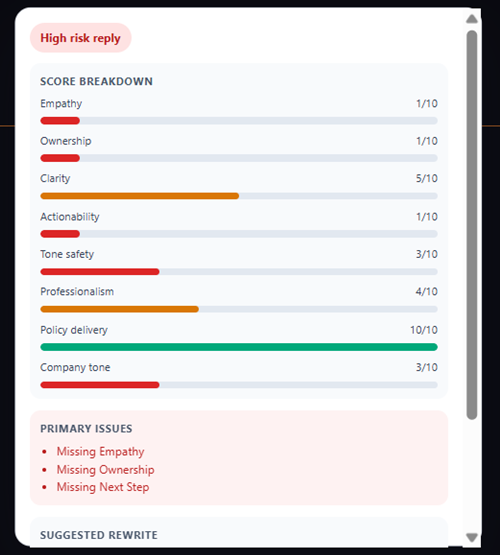 Every cost on this page attaches after the customer reads the reply. This is the moment
before.
Every cost on this page attaches after the customer reads the reply. This is the moment
before.
Support Coach flags blame, dead ends and cold tone in the agent's draft — never reading the customer's messages — and offers a rewrite in your company's voice. 14-day free trial: supportcoach.io/extension.
FAQ
Where are the industry statistics? Deliberately absent. Most "cost of bad service" numbers circulate without a checkable source, and a decision this small doesn't need them — your own ARPA and one honest incident memory are better data.
Isn't the occasional bad reply just the cost of doing support? The occasional mistake is. But a blame-worded or dead-end reply is a specific, detectable pattern — and a preventable cost stops being a cost of doing business the moment prevention exists.
Does prevention slow agents down? No — the instant checks add no delay, the full check is one optional click that returns in seconds, and nothing ever blocks sending.
Catch the risky reply before your customer reads it.
Support Coach works inside Zoho SalesIQ, Zendesk and Intercom. $15 per agent per month, 14-day free trial, no card.
See how it works →