Empathy statements for customer service (and why agents forget them mid-chat)
Support Coach AI · October 2026
A good empathy statement names the customer's actual situation, takes ownership of what happens next, and sounds like a person wrote it. "I understand your frustration" fails all three: it names nothing, promises nothing, and customers have read it ten thousand times. Below are empathy statements that work, grouped by the moment you need them — and, at the end, the honest reason most support teams already have a list like this and still don't use it.
The three parts of an empathy statement that lands
- Acknowledge the specific thing. Not "this situation" — the deleted invoice, the double charge, the third time they've asked.
- Own the next step. Empathy without action reads as a polite brush-off. Say what you are going to do.
- Sound like you. If a sentence could be pasted into any reply to any customer, it isn't empathy, it's a template — and customers can tell.
Empathy statements by situation
When something went wrong on your side
- "That shouldn't have happened, and I'm sorry it landed on you. Here's what I'm doing to fix it."
- "You did everything right here — this one's on us. Let me sort it out now."
- "I can see the charge went through twice. I'm reversing the extra one right now."
When the customer is frustrated or angry
- "Having to chase this for a week would wear anyone down. Let's get it closed today."
- "You've explained this more than once, and you shouldn't have had to. I've got the full picture now."
- "I'd be annoyed too if my order was this late. Here's exactly where it is and when it'll arrive."
When the answer is "no"
- "I can't restore that version, and I know that's not what you hoped to hear. What I can do is…"
- "That isn't something our plan includes today. Here's the closest option, and here's how to request the feature."
- "I wish I had a better answer on this one. Here's what will actually get you moving."
The rule for every "no": never let it be the last sentence. A refusal with a next step reads as help; a refusal on its own reads as a closed door.
When the customer made the mistake
- "Easy one to miss — the setting's tucked away. Here's where it lives, and I'll walk you through it."
- "That happens more than you'd think. Let's get it back to how you wanted it."
- "No harm done. Here are the two steps to undo it."
What not to write here: "You should have…", "As stated in our documentation…", "As I said before…". All three are accurate. All three read as blame.
When you need more time
- "I don't want to give you a half-answer. Let me check with the team and I'll update you within the hour."
- "This needs a proper look, not a guess. I'll come back to you by end of day with a real answer."
When the customer has waited too long
- "Thanks for waiting — that was longer than it should have been."
- "Sorry for the slow reply. You have my full attention now."
Phrases to retire
- "I understand your frustration." It's the most-used empathy line in support, which is exactly why it no longer sounds like empathy. Name the specific thing instead.
- "Unfortunately, we are unable to…" Two softeners stacked on a refusal. Say what you can't do plainly, then what you can do.
- "As per our policy…" Customers hear a wall. Explain the reason or the alternative, not the rulebook.
- "Please be advised…" Nobody talks like this. Delete it and start with the point.
- Copy-pasted apologies. If every reply opens with the same sentence, customers stop reading it.
Why agents still don't use them
Most support teams already have a list like this — in onboarding, in a wiki, in a macro folder. And still, mid-shift, replies go out cold. That isn't a knowledge problem. It's a timing problem:
- The risky reply is the confident one. An agent who knows the customer made the error doesn't stop to soften it. Nobody reaches for the empathy list on the reply they're sure about.
- Live chat runs at speaking speed. There's no pause in which someone remembers page three of the onboarding doc.
- The fiftieth chat of the day doesn't get the warmth of the first. Not because the agent stopped caring — because they're tired.
A list in a wiki can't help at the moment the reply is being typed. Something has to show up in the composer, on the draft, before send.
Getting the right phrasing at the moment it matters
That's the gap Support Coach was built for. It reads the agent's draft as they type — only the draft; the customer's messages never leave the browser — and when a reply reads as blame, a bare "no", or cold, it says so and offers a rewrite that keeps the agent's facts and adds the acknowledgment and next step. The agent can use it, edit it, or send their own. Nothing ever blocks sending.
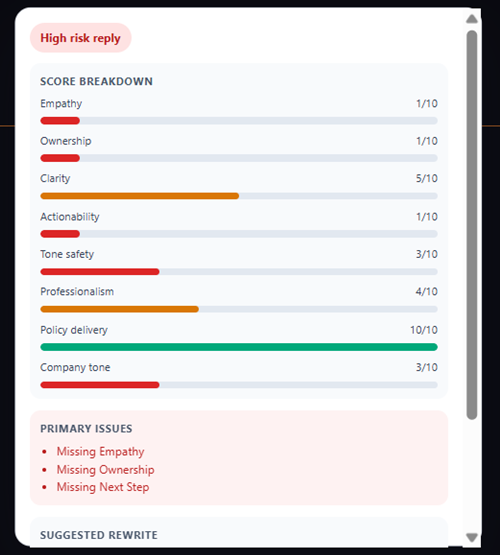 Missing empathy, flagged on the draft — while it can still change the reply.
And because the rewrite is written from what the agent actually typed — not pulled from a list — it fits the situation in front of them. Teams can also set phrases they always want — and ones they never want to see — in a company tone profile.
Support Coach works inside Zoho SalesIQ, Zendesk and Intercom, and was built for our own support team first. $15 per agent per month, 14-day free trial, no credit card: supportcoach.io/extension.
FAQ
What is an empathy statement in customer service? A sentence that shows the customer you've understood their specific situation — usually paired with what you'll do next. "I can see the order is five days late; I'm sending a replacement today" is an empathy statement. "I understand" on its own is not.
Should every reply start with an empathy statement? No. A quick factual question deserves a quick factual answer. Empathy matters most when the customer is frustrated, when the answer is "no", or when the mistake was yours.
Can't we just put these in canned responses? You can, and it helps with consistency — but canned empathy becomes the stock phrase customers learn to skip, and agents still have to remember to use it on the reply that needs it most.
Does Support Coach read the customer's messages? No. It evaluates only the reply the agent is drafting. Customer messages never leave the browser.
Catch the risky reply before your customer reads it.
Support Coach works inside Zoho SalesIQ, Zendesk and Intercom. $15 per agent per month, 14-day free trial, no card.
See how it works →