Grammarly for customer support? What a general writing assistant can't see in a support reply
Support Coach AI · September 2026
Grammarly checks whether a sentence is well written. It doesn't check whether the sentence is going to cost you the account. Plenty of support teams run Grammarly — it's roughly $12–15 per user per month with real tone detection, and for grammar and polish it's genuinely good. The question for a support team isn't whether Grammarly helps. It's what it can't see, because it doesn't know what a support reply is.
The reply Grammarly approves
Take a draft an agent is about to send:
"You entered it wrong, that's your mistake, and we can't fix it."
Grammatically? Nearly flawless. Clear subject, correct punctuation, no typos, confident tone. A general writing assistant has almost nothing to flag — this sentence is well written. It's also the kind of message that turns a support ticket into a cancellation, because it blames the customer, takes no ownership, and offers no way forward.
That's the gap in one example: the riskiest support replies are often clean prose. Blame, flat refusals, dead ends and cold closings are not writing errors. They're support errors, and you can only flag them if you're evaluating the message as a support reply — against empathy, ownership, next steps, and how tense the moment is.
Three things a support-specific coach does that a writing assistant can't
1. It scores support-specific risk. Support Coach evaluates a draft across eight dimensions — empathy, ownership, clarity, actionability, tone safety, professionalism, policy delivery, company tone. "Is there a next step?" is not a grammar question; it's the difference between a resolved customer and a stranded one.
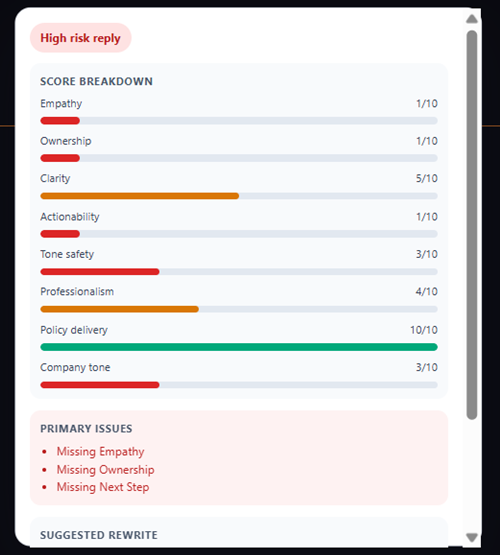 Clean prose, failing support reply. This is the case a grammar checker can't see.
2. It's scored against your voice, not a generic register. Your company has phrases it wants used and phrases it has banned. A general assistant polishes toward a universal "professional" tone; a support coach scores against the tone profile your team actually wrote.
3. It reports to the person who owns the outcome. Grammarly will never send your support manager a weekly summary of what the team was coached on. A support coach exists inside the manager's quality loop — that's half its job.
The honest version of "keep both"
If your team already has Grammarly and likes it, nothing here says drop it — polish is worth having. But at nearly the same price point ($15 per agent per month for Support Coach), "we already have Grammarly" is answering a different question than the one that costs money. Grammarly guards how the sentence reads. A pre-send coach guards what the sentence does — and it's the only one of the two that speaks up on the confident, clean, career-limiting reply above.
Support Coach coaches replies inside Zoho SalesIQ, Zendesk and Intercom — built for our own support team first. It never reads your customers' messages, only the agent's draft. 14-day free trial: supportcoach.io/extension.
FAQ
Does Support Coach replace Grammarly? Different jobs. Grammarly is general writing quality everywhere you type; Support Coach is support-reply risk inside your help desk. Teams run either or both — the overlap is smaller than the price similarity suggests.
Grammarly has tone detection — isn't that the same thing? Tone detection tells the agent how their text sounds. It doesn't score ownership, next steps or policy delivery, isn't calibrated to your company's voice, and produces nothing for a support manager.
Does either tool read the customer's messages? Support Coach doesn't — it evaluates only the agent's draft, and the customer's side of the chat never leaves the browser. We can't speak for other tools; ask any vendor this exact question.
Catch the risky reply before your customer reads it.
Support Coach works inside Zoho SalesIQ, Zendesk and Intercom. $15 per agent per month, 14-day free trial, no card.
See how it works →