Support QA for small teams: Thursday's review can't fix Monday's chat
Support Coach AI · September 2026
Quality assurance tools review support conversations after they end. For a small team, that timing is the whole problem: the review lands days after the customer read the reply — and the reply is what did the damage. If you run a 5–50 agent support team and you're pricing QA platforms, it's worth being precise about what you'd be buying, and what no QA tool can do by design.
What QA actually buys you
Dedicated QA platforms — Zendesk QA (formerly Klaus), MaestroQA (now Rippit), Loris, Playvox — have a real job: a reviewer or an auto-scorer grades finished conversations against a rubric, and over time you get pattern data. Which agents struggle with tone, which issue types go badly, whether coaching is landing. At enterprise scale, with dedicated QA staff, that loop earns its keep.
The going rate for the category is meaningful for a small team: Zendesk QA lists at roughly $35 per agent per month, and enterprise QA suites run to five figures a year at 10–30 agents. (Verify current pricing with the vendors — it moves.)
The structural limit: QA is a rearview mirror
Whatever it costs, QA shares one property: it happens after the customer has read the reply. The angry customer whose chat gets flagged in Thursday's review read "that's your mistake, we can't fix it" on Monday. The review can improve the next conversation; it is powerless about the one that was scored. And even within the review, the sentence that wrecked a conversation is easy to miss — rubric scoring grades the whole exchange, and one blame-worded line in an otherwise clean chat blindsides the reviewer just as it blindsided the agent. For a large operation smoothing averages across thousands of chats, that trade is fine. For a small team, one badly handled chat can be a churned account — the average was never the point.
There's a second small-team problem: someone has to do the reviewing. QA platforms assume review capacity. In a 10-agent team, the "QA program" is usually the support manager reading transcripts at 9pm.
The alternative timing: check the reply before it goes out
Pre-send coaching inverts the sequence. Instead of a reviewer scoring the conversation after it ends, a pre-send coach evaluates the agent's draft — flagging blame, missing ownership, dead-end refusals and cold tone while the message is still editable, and offering a rewrite in your company's voice. The manager still gets pattern data (a weekly summary of what the team was being coached on), but the primary effect happens where QA can't reach: before send.
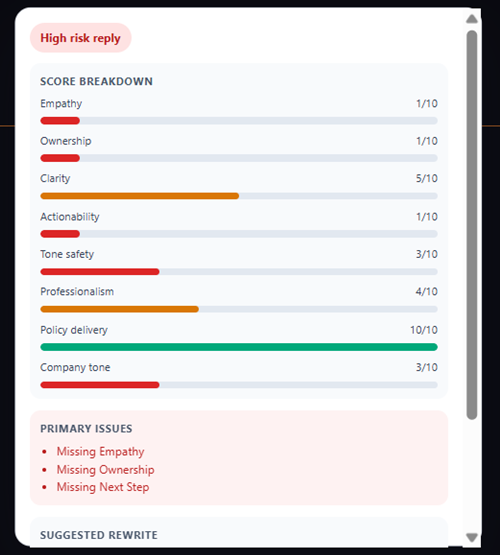 The review a QA tool would deliver on Thursday, delivered while the reply is still
editable.
The review a QA tool would deliver on Thursday, delivered while the reply is still
editable.
The honest comparison, since the categories genuinely differ:
| Post-hoc QA | Pre-send coaching | |
|---|---|---|
| When it acts | After the conversation | While the reply is a draft |
| Can it prevent a bad reply? | No — by design | Yes, that's the job |
| Pattern reporting | Yes, deep | Yes, lighter (weekly summary) |
| Review labor needed | Yes | No |
| Typical price | ~$35/agent/mo | $15/agent/mo (Support Coach) |
Bigger teams reasonably run both. For a small team choosing one, the question is which failure you'd rather fix: not knowing your quality patterns, or letting the preventable reply reach the customer.
Support Coach coaches replies before they're sent, inside Zoho SalesIQ, Zendesk and Intercom — built for our own support team first. $15 per agent per month, 14-day free trial: supportcoach.io/extension.
FAQ
Is pre-send coaching a replacement for QA? For a small team it usually replaces the QA purchase — it covers prevention plus lightweight reporting. It doesn't replace deep rubric-based review programs; teams with dedicated QA staff run both.
Doesn't the agent's help desk already do this? Help desks' built-in writing tools rewrite when the agent asks. They don't flag issues on their own — and the risky reply comes from the agent who doesn't ask.
What does it do to agent autonomy? Nothing blocks sending. The coach flags and suggests; the agent decides. Managers see weekly patterns, not keystroke surveillance — and the tool never reads the customer's side of the chat.
Catch the risky reply before your customer reads it.
Support Coach works inside Zoho SalesIQ, Zendesk and Intercom. $15 per agent per month, 14-day free trial, no card.
See how it works →