Pre-send coaching, defined: catching the risky support reply before the customer reads it
Support Coach AI · September 2026
Pre-send coaching means reviewing a support agent's draft reply before the customer reads it — catching blame, missing ownership, or a flat "no" with no next step while the message can still be fixed. In practice, a pre-send coach is a tool that lives in the agent's composer: it flags the risk and offers a ready-to-send rewrite. The category sits in the gap between two kinds of tooling that already exist: quality assurance (which reviews conversations after they happen) and AI writing assistants (which help only when the agent asks).
The gap it fills
Support teams already have two kinds of help with reply quality, and both miss the same moment.
QA tools review afterwards. Platforms like Zendesk QA (formerly Klaus) score finished conversations against a rubric, typically around $35 per agent per month. For the problem on this page, that design has two built-in limits. Timing: by the time a reviewer reads the chat, the customer read it days ago — Thursday's review can't unsend Monday's reply. And focus: QA grades whole conversations for patterns, and the single sentence that wrecks one is usually buried in an otherwise fine chat — it blindsides the reviewer just as it blindsided the agent. Even when it's caught, it's caught after.
Writing assistants help when asked — and "when asked" is the whole limitation. Help-desk composers increasingly ship some form of rewrite button: the agent selects their text, requests a polish, gets one. The vendors' own documentation is consistent: these features act on the agent's request and flag nothing on their own. A rewrite button is a bystander to the reply nobody asks about.
Here's the problem with both: the reply that escalates a conversation is almost never one the agent thought to double-check. An agent typing "you entered it wrong, that's your mistake" is confident and in a hurry. They will not click a rewrite button, and a QA review will find the chat long after the customer is gone. Pre-send coaching exists for exactly that moment — it speaks up when the agent doesn't ask. That unprompted detection isn't a feature layered onto the category; it is the category's reason to exist.
How it works in practice
A pre-send coaching tool typically layers three levels of intervention:
- Instant hints while typing. Lightweight rule-based checks — no AI, no latency — that flag clear risk patterns like blame language as the agent types.
- A coaching suggestion when the agent pauses. An AI reads the draft and offers a better version alongside it, without interrupting.
- An on-demand pre-send check. The agent clicks once before sending and gets a quality score across dimensions like empathy, ownership, and next steps — plus a complete rewrite in the company's own voice, ready to send or edit.
The escalation matters: most keystrokes need no help, so the always-on layer stays cheap and silent, and the thorough (AI) layer runs when it's wanted.
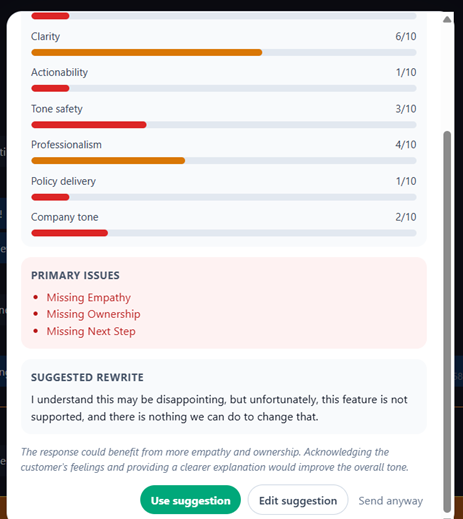 A pre-send check on a real draft: scores, the issues found, and a ready-to-send rewrite
— with "send anyway" always available. Nothing blocks the agent.
A pre-send check on a real draft: scores, the issues found, and a ready-to-send rewrite
— with "send anyway" always available. Nothing blocks the agent.
What it shouldn't need to read
A detail worth checking on any tool in this category: it should not need your customers' messages. A well-built pre-send coach evaluates only the agent's own draft — the customer's side of the conversation never needs to leave the browser. That single design choice is what makes the category deployable without a heavyweight security review: there's no customer conversation data to protect because none is collected.
Who it's for
Pre-send coaching matters wherever replies are fast, typed under pressure, and unreviewed — live chat above all. Enterprise contact centers have had real-time agent assist for years (Cresta, Level AI, Balto — typically six-figure annual contracts). Pre-send coaching brings the same idea to everyone else at a per-seat price closer to what the QA class charges — and team size doesn't gate the benefit: a risky reply reaching a customer costs the same whether it came from a solo support inbox or a fifty-agent floor.
Support Coach is a pre-send coaching extension for Zoho SalesIQ, Zendesk, and Intercom — built for our own support team first. $15 per agent per month, 14-day free trial: supportcoach.io/extension.
FAQ
Is pre-send coaching the same as QA? No. QA reviews conversations after they end; pre-send coaching intervenes while the reply is still a draft. Many teams run both — QA for patterns, pre-send for prevention.
Does it slow agents down? The instant layer adds no delay, and the full AI check is one optional click that returns in a few seconds. Nothing blocks sending.
Does it read customer messages? A properly built one doesn't need to. Support Coach evaluates only the agent's draft; the customer's messages never leave the browser.
How is it different from Grammarly? Grammarly checks whether a sentence is well written. Pre-send coaching checks whether the sentence will cost you the account — support-specific risks, scored against your company's voice, with reporting a support manager can use.
Catch the risky reply before your customer reads it.
Support Coach works inside Zoho SalesIQ, Zendesk and Intercom. $15 per agent per month, 14-day free trial, no card.
See how it works →