Why good support agents send bad replies
Support Coach AI · September 2026
Good agents send bad replies because nothing in a live-chat queue asks them to look twice at the message they're most sure about. It isn't a training gap or an attitude problem — the same agent who de-escalates one chat beautifully can, twenty minutes later, send "that's your mistake, we can't fix it" and mean nothing by it. Understanding why is the difference between fixing the problem and just running another training session.
Four honest reasons
1. Confidence removes the pause. The replies that damage relationships are almost never the ones an agent hesitated over. Hesitation triggers re-reading; certainty doesn't. An agent who knows the customer made the error types it plainly, hits send, and moves to the next chat. Factually right, relationally expensive — and by definition unreviewed, because reviewing is what uncertainty does.
2. Live chat runs at speaking speed. Email gives a reply minutes of natural lag in which second thoughts happen. Chat gives it seconds. A queue of waiting customers is a constant tax on any instinct to slow down, and the faster an agent gets — a thing we otherwise reward — the smaller the window in which a bad sentence could get caught.
3. Empathy fatigue is real and daily. The tenth "where is my refund" of the shift does not get the warmth the first one did. The agent isn't rude; they're depleted. But the customer only sees message ten, and message ten reads cold — a flat answer with no acknowledgment, no ownership, no next step.
4. Mid-conversation blindness. Deep in a thread, an agent's reply makes perfect sense to them — they have the full context in their head. "As I already explained" feels like a fact from the inside and reads like an accusation from the outside. Nobody re-reads their own message as a stranger; that's precisely the skill nobody has at 4pm on a busy Tuesday.
Why the usual fixes miss
Training addresses none of these, because none of them is a knowledge gap — the agent who sent the cold reply could tell you exactly what a warm one looks like. After-the-fact review (QA scorecards, transcript reads) catches the pattern weeks later, coaches the agent for the next conversation, and does nothing for the customer who already read the message. Both tools assume the problem is what agents know. It's when anyone looks.
What actually closes the gap
The reply needs a second reader in the only moment that matters: after typing, before send. That's what pre-send coaching does — it reads the draft (only the draft; never the customer's messages), flags blame, missing ownership, dead ends and cold tone, and offers a rewrite in the company's voice the agent can use, edit, or ignore.
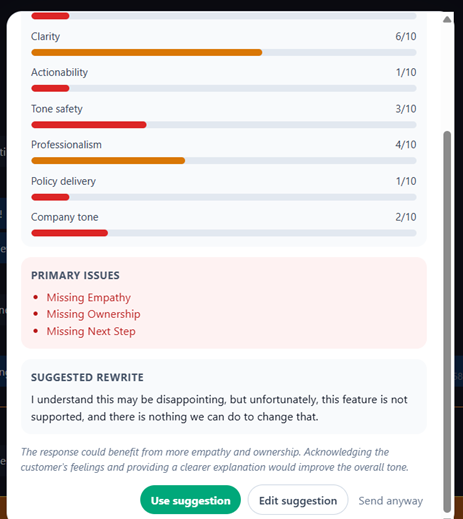 The second look, at the only moment it can still change the outcome.
The point isn't surveillance and it isn't distrust of agents — it's that the four causes above apply to everyone, including your best people, including whoever is reading this. A coach that only ever speaks up when a draft carries real risk gives the confident agent the pause that confidence removed.
Support Coach does exactly this, inside Zoho SalesIQ, Zendesk and Intercom — built for our own support team first. $15 per agent per month, 14-day free trial: supportcoach.io/extension.
FAQ
Isn't this just a hiring/training problem? No — the agents sending these replies usually know better. All four causes are situational (confidence, speed, fatigue, context-blindness), which is why they survive training and hit experienced agents too.
Won't agents resent a tool checking their drafts? Agents resent noise. A coach that stays silent on good replies and never blocks sending reads as help, not policing — and nothing about it reports keystrokes; managers see weekly patterns, not surveillance.
Does it read the customer's side of the chat? No. It evaluates only the reply the agent is drafting. Customer messages never leave the browser.
Catch the risky reply before your customer reads it.
Support Coach works inside Zoho SalesIQ, Zendesk and Intercom. $15 per agent per month, 14-day free trial, no card.
See how it works →